Why a Lansing Home Sale Can Hinge on a Driveway Nobody Thought to Question
September 10, 2026
September 10, 2026
If the well on your property has supplied clean water for fifteen years, why would a lender make you test it again before your buyer can close? The honest answer is that your lender never cared how the water tasted. It cares about the documentation behind the test, and that is a detail most sellers in Lansing never think to check until it is sitting between them and a closing date.
The same blind spot shows up one driveway over. According to NCFHAExpert.com, a gravel lane that has carried trucks, school buses, and moving vans for thirty years without complaint can still stop a USDA loan cold if nobody has documented who is responsible for keeping it that way.
The driveway issue is a USDA underwriting requirement, and it trips up sellers for the same reason. Long ownership creates confidence. A well that has always tasted fine feels tested. A driveway that has always worked feels sound. But a government-backed underwriter does not accept lived experience as evidence. It wants documentation, and in Lansing, where a large share of the housing stock sits on private gravel roads and private wells, that gap between what an owner knows and what a lender will accept shows up constantly.
Most of what sells around Lansing isn't a subdivision home on a paved cul-de-sac. It's acreage and riverfront tracts in communities like River Hills and Preserve on the New River, built around gravel driveways, private wells, and septic systems rather than municipal water and sewer. That property type is exactly what USDA's Rural Development loan program was built to finance, and USDA Properties reports that Ashe County has no geographic USDA loan restrictions, meaning nearly the entire county, Lansing included, qualifies.
As of a 2024 program snapshot, the income ceiling for a four-person household in Ashe County sat close to $90,300, a figure well above what many local wage earners actually bring home. That gap matters. It means USDA financing isn't a fallback for buyers who couldn't qualify for something better. For a lot of Lansing purchases, it's simply the loan that fits both the buyer's income and the property type. That same 2024 snapshot counted roughly 141 active USDA-backed loans across the county, with an average balance near $130,682, a scale that tells you this is routine financing here, not a rare exception.
That routine status is exactly why the driveway rule and the well rule matter so much locally. If USDA touched only a handful of Lansing sales, these would be edge cases worth a footnote. Because it touches so many, they are conditions worth planning around before a property ever hits the market.
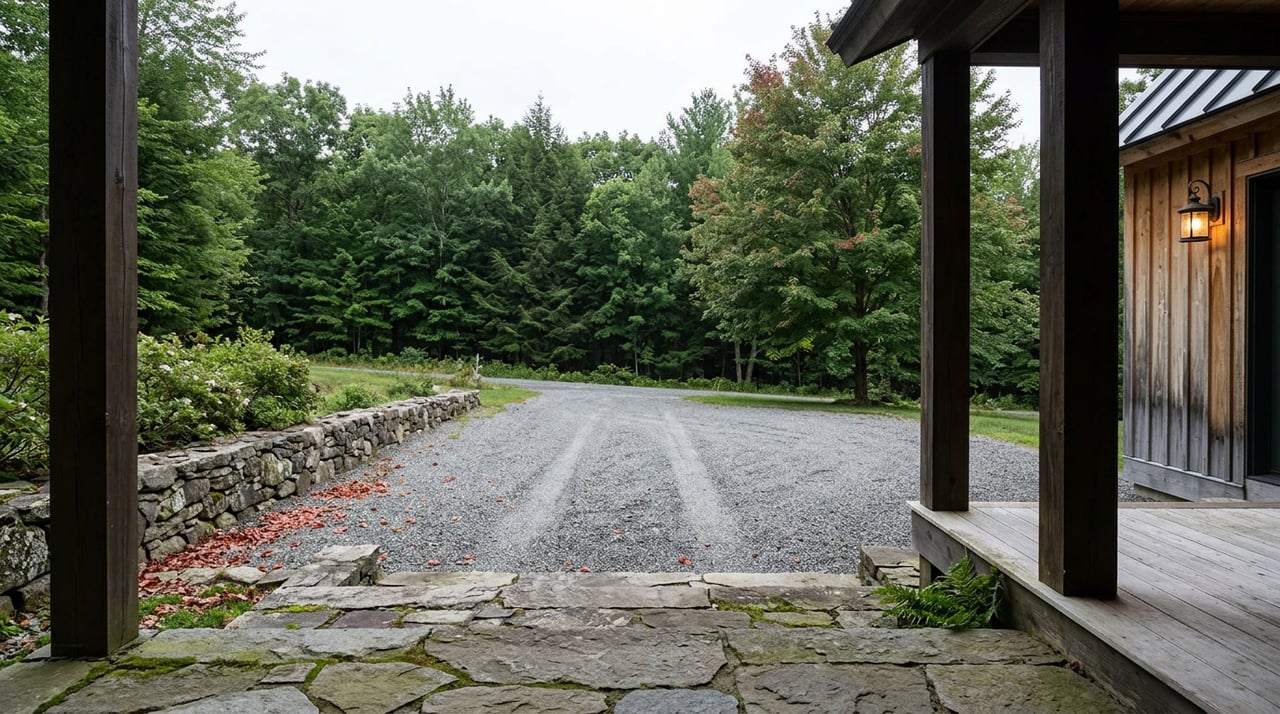
USDA guidelines require that the private street or driveway serving a financed home have a hard-surfaced or all-weather surface. Gravel, packed stone, or pavement satisfies that standard. A bare dirt lane does not, no matter how long it has held up under normal use. Underwriters have turned down closings over exactly this detail, treating a dirt driveway off a private street the same way they would treat a missing roof.
When more than one household shares that road, the second layer of scrutiny kicks in. Lenders commonly want to see a recorded road maintenance agreement, one that spells out who pays for grading and gravel and that has some evidence of actual dues being collected, not just an old easement that says the road exists. A verbal understanding among neighbors, however long it has worked in practice, often isn't enough to satisfy an underwriter reviewing the file for the first time.
Here's the rule of thumb worth remembering before you ever list a property like this:
If neighbors only have a verbal understanding about road maintenance, an underwriter may still ask for a recorded agreement.
As Lancaster Law Firm explains, road maintenance agreements are recommended in North Carolina, not mandated. But recommended and required start to mean the same thing the moment a mortgage company is the one asking.
| Property Detail | What Satisfies a USDA Underwriter | What Doesn't |
|---|---|---|
| Driveway surface | Gravel, packed stone, or pavement maintained as an all-weather surface | A bare dirt lane, even one that's "always been fine" |
| Shared private road | A recorded maintenance agreement with an active reserve or dues history | A verbal understanding among neighbors, no matter how long it's worked |
| Test timing | Fresh enough to fall inside the lender's validity window | An old test the seller happens to have on file |
Testing matters because a meaningful share of wells don't pass cleanly. Testing data from state-certified labs shows that somewhere between 8 and 14 percent of North Carolina wells fail on at least one tested parameter, most often bacteria or nitrates. A failed result doesn't kill a sale on its own. It usually means treatment, a retest, or a negotiated credit, and none of those are unusual outcomes in a county full of decades-old private wells.
The bigger risk is timing. Basic loan-panel results typically take five to ten business days to come back, and comprehensive panels covering heavy metals or pesticides can run ten to twenty-one days.
For land without an existing well, this same logic extends to septic. Ashe County's rocky terrain and clay-heavy soil mean a percolation test result on one parcel says very little about the parcel next door
The properties that look most move-in ready to a buyer's eye, the ones with a settled gravel drive and water that's always tasted fine, are often the ones with the least paperwork behind them. Nobody documents what has never caused a problem. That's precisely why these two details surprise sellers so often here. The issue was never the water or the road. It was the absence of a record proving either one had ever been checked the way a lender checks it.
Does this only apply to USDA loans? The driveway surface standard comes specifically from USDA guidelines, but FHA and VA loans carry their own access and safety requirements for the road serving a property.
Does the driveway surface rule change if I'm the only house on my private road? The driveway surface rule still applies regardless of how many households use the road.
What if my well has never been tested? That's common on properties that have been in the same family for decades. It doesn't kill a sale. It just means budgeting five to twenty-one business days for results, depending on the panel, and building that into your listing timeline rather than your closing timeline.
Does the driveway still need to meet the surface standard if the road is already state-maintained gravel? The individual driveway connecting the house to that road still needs to meet the same surface standard.
If you're getting a Lansing property ready to list, or trying to figure out what a specific parcel's road and water setup means for your financing options, A-1 Mountain Realty can walk the ground with you before a buyer's underwriter ever does. Schedule a free consultation and let's find out what your file actually needs before it becomes a closing week surprise.
This article is general information, not legal, tax or financial advice. Consult a qualified professional about your situation.
Stay up to date on the latest real estate trends.
We pride ourselves in providing personalized solutions that bring our clients closer to their dream properties and enhance their long-term wealth. Contact us today to discuss all your real estate needs!
PHYSICAL ADDRESS: 1 N Jefferson Ave West Jefferson NC 28694 MAILING ADDRESS: PO Box 828 West Jefferson NC 28694